
Why Your Business Name Matters
A business name is often the first piece of your brand that customers see or hear. It may appear on your website, logo, storefront, invoices, social profiles, packaging, email address, search results, advertising, and official registrations.
A strong name does not need to be clever or unusual. It needs to support the business. The best option is usually easy to understand, easy to repeat, suitable for the intended audience, and flexible enough to remain useful as the company grows.
Important: a creative name is only a candidate until you have checked legal, registry, domain, social, and marketplace availability. A business name generator can help with ideas, but it cannot confirm that a name is legally safe or available.
What to Define Before You Brainstorm Names
Naming becomes easier when you know what the name needs to communicate. Write a short naming brief before generating ideas.
1. What does the business sell or provide?
Define the main product, service, or customer outcome. A local repair company may need clarity and trust, while a fashion label may benefit from a more distinctive or emotional name.
2. Who is the target customer?
Consider the audience’s language, expectations, location, age range, industry, and buying context. A name for corporate buyers may need a different tone from a name for children’s products or a neighborhood café.
3. What should the brand feel like?
Choose three to five qualities such as professional, friendly, premium, local, modern, practical, bold, calm, technical, playful, natural, or traditional.
4. How far might the business grow?
Think about future services, products, locations, and markets. A very narrow name can become a problem when the business expands beyond the original offer or city.
5. What must the name avoid?
List words, claims, locations, styles, meanings, initials, or competitor similarities that would create confusion or misrepresent the brand.
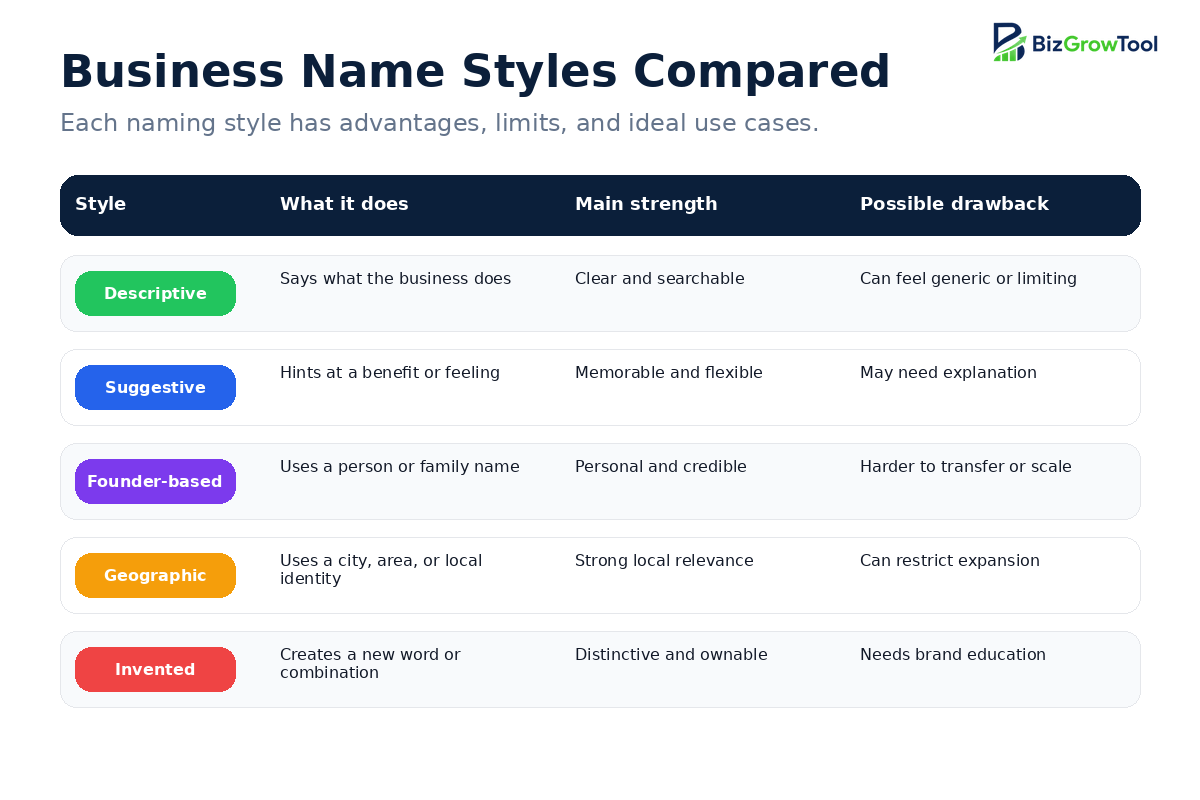
Five Common Business Name Styles
Different naming styles serve different goals. No style is automatically better; the right one depends on your market, brand position, and growth plan.
Descriptive names
Descriptive names explain the product, service, customer, or location directly. They can be clear and practical, especially for local services, but may feel generic and can become limiting.
Suggestive names
Suggestive names hint at a benefit, feeling, process, or brand idea without stating the offer literally. They can be memorable and flexible while still giving customers a useful clue.
Founder-based names
Founder or family names can create personal credibility and work well for professional services, family businesses, designers, consultants, and practices. They may be harder to transfer or reposition later.
Geographic names
Geographic names can communicate local relevance and community connection. They may be useful for a location-focused business but can make expansion into new regions feel less natural.
Invented or blended names
Invented names use new words, altered spellings, syllable combinations, or blended concepts. They may be distinctive and easier to own as a brand, but customers often need more explanation at the beginning.
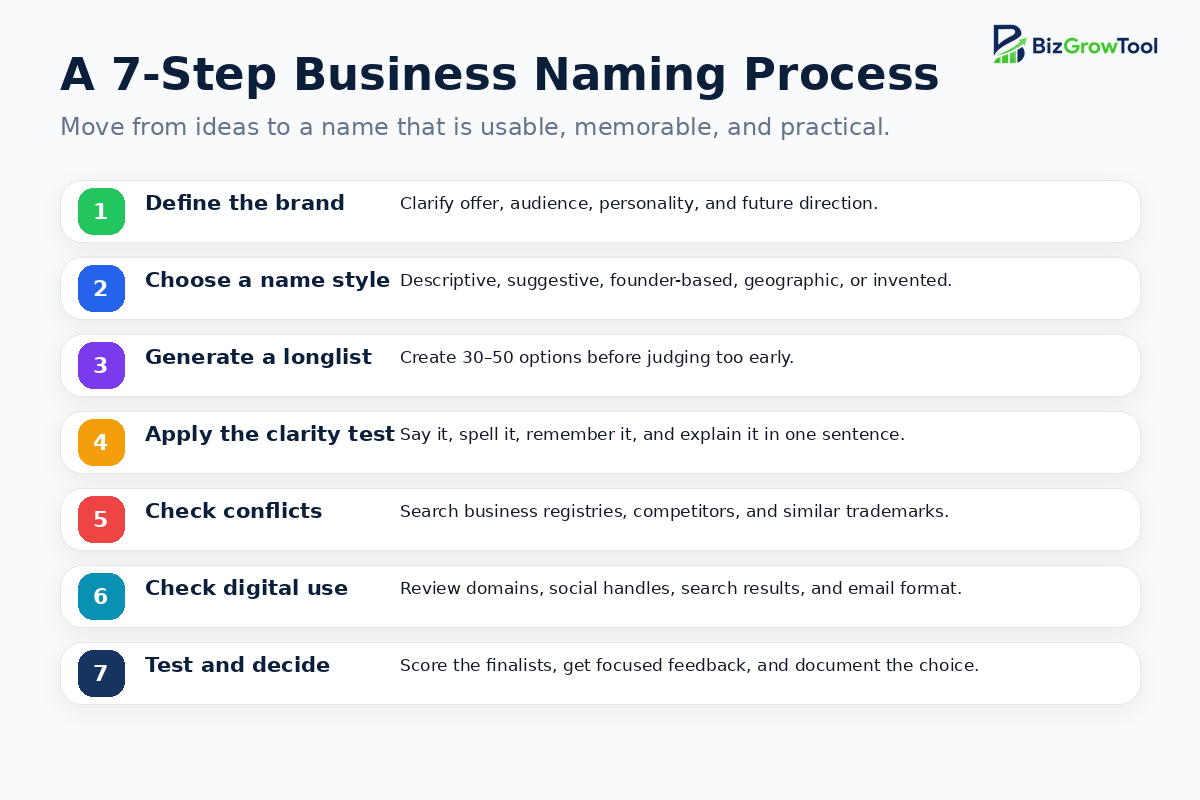
How to Choose a Business Name: Seven Steps
Step 1: Define the brand direction
Use the naming brief above to define the offer, audience, tone, future direction, and restrictions. Without this step, a shortlist may contain attractive names that do not fit the actual business.
Step 2: Select two or three naming styles
Do not limit the entire brainstorm to one direction. For example, create one descriptive list, one suggestive list, and one invented list. Comparing styles makes the final decision more deliberate.
Step 3: Create a longlist before judging
Generate at least 30 to 50 options. Combine customer benefits, services, locations, values, founder names, metaphors, sounds, and relevant words. Separate idea creation from evaluation so promising directions are not rejected too early.
Need more naming directions?
Use the free BizGrowTool Business Name Generator to explore descriptive, modern, professional, local, premium, friendly, and brandable name ideas. Treat every result as a brainstorming suggestion and complete the availability checks before use.
Step 4: Apply the clarity and memory tests
Remove names that are unnecessarily difficult to pronounce, spell, type, remember, or explain. A name can be unusual, but the difficulty should support the brand rather than create constant friction.
Step 5: Search for conflicts and confusion
Search the name, close variations, common misspellings, sound-alike versions, and similar names used in related industries. Do not rely only on an exact-match search.
Step 6: Check digital practicality
Review suitable domain names, social handles, email appearance, search-result competition, and how the name looks without spaces. The exact .com is helpful but not the only workable domain option; clarity, trust, and consistent use matter more than forcing an awkward spelling.
Step 7: Score, test, and decide
Score the finalists against consistent criteria. Ask a small number of target customers or trusted reviewers what they think the business offers, how they would spell the name, and which option they remember later. Use feedback as evidence, not as a popularity contest.
Five Practical Tests for Every Name
The phone test
Say the name once as if you are answering a phone. Can the listener repeat and spell it without a long explanation?
The search test
Search the exact name, similar versions, misspellings, and the name plus your industry. Look for confusion and established competitors.
The growth test
Would the name still make sense if you added products, served new locations, hired a team, or moved into a related service?
The visual test
Write the name in lowercase, uppercase, a domain format, an email address, and a simple logo line. Check for awkward word combinations.
The memory test
Share several options without explaining them. Ask the reviewer the next day which names they remember and what each suggested.
The meaning test
Check slang, pronunciation, cultural meaning, and unintended interpretations in the languages and markets you plan to serve.
How to Check Whether a Business Name Is Available
Name availability is not one single check. Registration, trademark, domain, and social use are separate issues.
1. Search the relevant business registry
Check the official state, national, provincial, or local business registry that applies to your structure and location. The U.S. Small Business Administration explains that entity names, trademarks, DBA registrations, and domain names protect different things and may involve different agencies or requirements.
2. Search trademarks and similar marks
Search for identical and similar names used with related goods or services. The USPTO notes that a comprehensive clearance search may include the federal trademark database, state trademark databases, and internet research. Similarity in sound, appearance, meaning, or commercial impression can matter—not only exact matches.
Legal note: this article is general educational information, not legal advice or a trademark clearance opinion. For an important launch, investment, or national brand, consider getting advice from a qualified trademark professional in your jurisdiction.
3. Check competitors and general search results
Search the proposed name with your product category, city, industry, and customer terms. Look for businesses that could create confusion even when the exact legal registration appears available.
4. Check domains
Review practical domain options through a reputable registrar. Consider the exact name, a clear industry modifier, or a location modifier. Avoid unnecessary hyphens, confusing numbers, and spellings that customers will repeatedly mistype.
5. Check social handles and major platforms
Search the platforms that matter to your audience. Exact matching handles are useful but not mandatory. A consistent and readable variation is usually better than an awkward name chosen only because every handle is available.
6. Document what you checked
Save the search date, registries, trademark searches, domains, handles, and competitor results you reviewed. Availability can change, and documentation helps your team understand how the decision was made.
Official references: U.S. Small Business Administration — Choose your business name and USPTO Trademark Search.
Business Name Examples by Direction
The following are illustrative patterns, not cleared names. They may already be in use. Always complete your own registry, trademark, domain, competitor, and social checks before using any name.
Local service business
[Trust word] + [Service]
[Founder name] + [Trade]
Useful when local clarity and immediate understanding are more important than creating an abstract brand.
Professional consultancy
[Direction word] + Partners
[Founder] + Consulting
Professional names often benefit from confidence, clarity, and room to add services later.
Ecommerce brand
[Invented word] + Co.
[Lifestyle idea] + Studio
Ecommerce names should be distinctive, easy to type, and broad enough to support future product categories.
Restaurant or café
[Ingredient] + Table
[Founder or location] + Café
Food businesses can use atmosphere, origin, specialty, neighborhood, or founder identity as naming material.
Creative studio
[Craft word] + Works
[Invented word] + Creative
A creative name can be expressive, but clients should still be able to pronounce, search, and remember it.
Software or startup
[Action] + Flow
[Invented blend] + Labs
Startup names often prioritize flexibility and distinctiveness, but should avoid confusing spelling and pronunciation.
Business Name Shortlist Scorecard
Give each finalist a score from 1 to 5 for the following criteria. A high total does not automatically make a name legally available, but it creates a consistent comparison.
| Name candidate | Clarity | Memory | Flexibility | Availability | Audience fit | Total / 25 |
|---|---|---|---|---|---|---|
| Candidate A | 4 | 5 | 4 | 3 | 5 | 21 |
| Candidate B | 5 | 3 | 3 | 5 | 4 | 20 |
| Candidate C | 3 | 4 | 5 | 4 | 4 | 20 |
Common Business Naming Mistakes
- Choosing the first acceptable idea: create and compare a wider list before committing.
- Checking only an exact trademark match: similar wording, sound, meaning, and related goods or services can also matter.
- Choosing for domain availability alone: an available domain does not make a weak or conflicting business name safe.
- Using difficult spelling without a reason: customers may struggle to search, recommend, or type the name.
- Being too narrow: a single product, service, or city in the name may restrict future expansion.
- Being too generic: a name that only describes the category may be difficult to distinguish and protect.
- Copying a competitor’s naming pattern: similarity can create customer confusion and weaken your own identity.
- Ignoring unintended meanings: check word combinations, slang, pronunciation, initials, and relevant languages.
- Asking everyone for opinions: broad feedback can become contradictory. Test with a small, relevant group using specific questions.
- Launching before checks are complete: rebranding signs, packaging, domains, profiles, and legal documents can be expensive.
Final Business Name Checklist
- Does the name fit the real offer and target customer?
- Can most customers say, spell, type, and remember it?
- Does it support the intended brand tone?
- Would it still fit if the business grows?
- Have you searched the relevant business registry?
- Have you searched identical and similar trademarks?
- Have you checked competitors and general search results?
- Is there a practical domain and email format?
- Are suitable social handles available or adaptable?
- Have you checked meanings, abbreviations, and pronunciations?
- Have you recorded your research and decision?
- Have you obtained professional legal advice when the risk or investment justifies it?